

Seeing the Software in the Stone
A Meditation on Scope & Sculpture

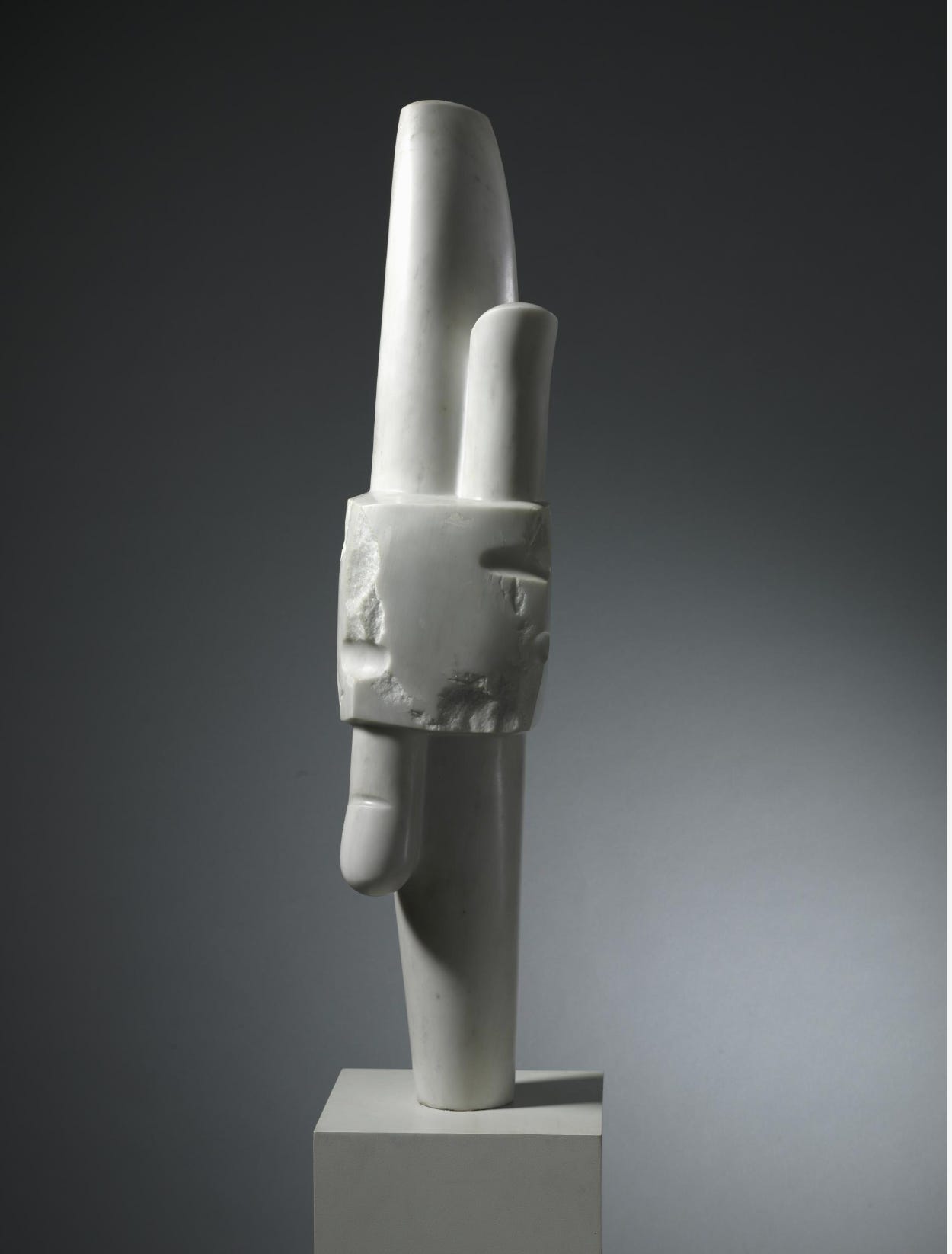
I’ve been thinking about a particular sculpture since visiting the Cleveland Museum of Art recently. A piece called "Mother and Child” by Isamu Noguchi. I adore art, but it wasn’t a topic I expected to obsess over in a week full of reports, emails, and design meetings.
Noguchi said: “Everything is sculpture. Any material, any idea without hindrance born into space, I consider sculpture.”
I don’t know why that keeps finding me in the middle of software projects. But it does.
My background is in music composition, and I’ve had many a debate about what separates art from craft — whether they’re different things at all, or just different moods of the same impulse. In 2010, a developer told me he considered himself a craftsman and that code was art. I was skeptical. I told him to focus on the most efficient path to done. Earlier in my career, my boss John had made sure my job was to squelch exactly that kind of thinking — keep to tasks, hold the scope line, leave no room for creative drift or risk or the thing we called scope creep, as if curiosity were a disease.
I’ve softened on that developer. I think he was right and I wasn’t ready to hear it.
There are really only two kinds of work in sculpture. Addition and subtraction.
Clay welcomes accumulation — you build up, layer by patient layer, trusting that form emerges from what you put in. Stone demands the opposite. You take away. Carefully. Irreversibly. And you have to trust that what you’re after is already present, waiting.
Software works exactly this way. Most teams just never name it.
Additive work is where most of us live. An existing system. A backlog. A scaffold someone else built, with decisions baked into the foundation you didn’t make and can’t fully see. You’re extending something. The constraints are inherited. Your job is to build without breaking what’s already holding weight. That takes real skill. Real craftsmanship.
Subtractive work is rarer. And harder. It asks you to hold the ideal form in your mind before the material cooperates. To deprecate what doesn’t belong. To say *not this* as a deliberate act, not a defeat. To keep cutting until the thing that was always in there can finally breathe.
I recently left a project where leadership was performing what they called a lift-and-shift — different database, different middle tier, new customer experiences inside and out. Nothing was being saved. A complete rewrite. What they didn’t realize was that nobody had documented the business rules that needed to be coded. IT said they’d reverse-engineer from the existing code. The business said “good luck, because no one on our team was here when we built it.”
A lump of marble. No sculptor. No image in the stone.
The part no one talks about enough is the armature.
In clay work, the armature is the internal structure — wire, dowel, whatever holds the form while you work. Nobody sees it in the finished piece. But get it wrong and nothing else matters. The whole thing collapses under its own weight eventually, no matter how beautiful the surface looks in the meantime.
I’ve worked on projects with no armature. You probably have too.
They call it emergent architecture. It’s a polite term for a death sentence written in the first sprint.
There’s also the question of surface. Texture. Finish. The sculptor who leads with surface and ignores structure produces something that looks right and holds nothing. I’ve shipped features like that. Polished. Purposeless. Nobody’s proudest work.
The serious sculptor walks around the piece. Considers how it reads from every angle. Thinks about negative space — what’s absent, what the eye fills in, what the form implies beyond what it states. That’s product thinking at its most honest. Not just what are we building but what does this become in the hands of someone we’ll never meet, in a context we didn’t design for.
In 2013 I worked on something genuinely new — new to the industry, new to the business, the kind of project that comes along rarely. A real masterpiece in the making. Blood, sweat, and teams of sculptors pouring themselves into the stone.
They shelved it. Another priority. Millions in investment, quietly archived.
I still think about that one.
People ask whether it’s better to plan everything upfront or work iteratively, as if those are opposites.
They’re not. They’re different moments in the same contemplative practice.
You need enough stillness at the beginning to sense what’s in the stone. You need enough willingness to begin before the vision is complete. The sculptor doesn’t chisel randomly. But they also don’t wait for certainty before they pick up the tool.
You hold the image loosely. You let the material teach you. You remove what it isn’t, one careful cut at a time, and you try to recognize the thing when it finally starts to appear.
That’s the closest I’ve come to a formula. And some days, that’s enough.