

Let It Fail
Trying to catch everything gracefully is a lie

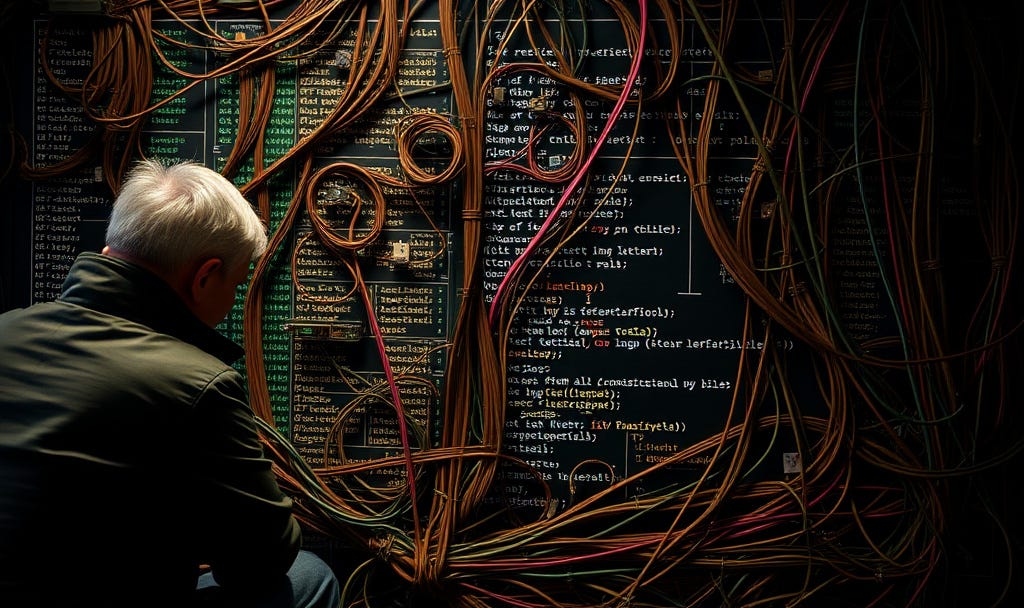
There’s a moment when the most experienced person in the room looks at a tangle of Try/Catch code and says the thing nobody wants to hear:
Remove it. If this fails, let it fail.
A try/catch block intercepts an error before it becomes visible. It patches the problem and lets the system keep running. From the outside, everything looks to be humming. Internally, something is quietly wrong — and the mechanism designed to protect the system is now protecting the system from knowing it’s broken.
We do this constantly. Catch blocks around grief. Around the conversation we should have had five years ago. Around the belief we took as truth. The error keeps firing. We keep catching it before anyone — including us — has to see it clearly. We keep on humming along.
Thomas Merton wrote that the biggest human temptation is to settle for too little. Not vice, not cruelty — just the daily choice to keep the lights on rather than find out what’s wrong with the wiring.
AI is, at its core, a very sophisticated catch block. It intercepts the friction of not knowing, of having to sit with an unanswered question long enough for it to do something to you. It fills the silence before the silence can teach you anything.
There’s a principle — the map is not the territory — that says our mental models are representations, not the thing itself. Useful. Necessary. But with edges, distortions, and blank spaces where the cartographer didn’t know what to draw.
I gave Ai a chance to build my map. Drawing from everything I’ve given it — my questions, my framings, my blind spots baked into how I ask things — and reflecting it as a coherent picture. Not the territory. A portrait of my existing understanding, served back with confidence. And a very good map makes you less likely to look up. Everything is already labeled.
I noticed that when AI doesn’t know something, it doesn’t stop. It fills in. Generates a plausible answer from the shape of what surrounds the gap. Delivers it in the same confident register it uses for everything else. Then, at the bottom: this response may be inaccurate. Please verify important information.
The caveat is the catch block.
You never saw the failure — you saw an answer. And you moved on because the answer was fluent, the caveat was easy to miss, and you just needed something to work.
After a long 1:1 conversation about exactly this with a co-worker, I opened a chat window and asked AI to build me an app to manage my life — drawing on everything we’d ever discussed.
It built one. Disturbingly good. It knew what I avoided. It knew how I thought. My patterns are reflected in a clean interface with nothing wasted.
I had just spent two hours on the spiritual cost of outsourcing ourselves to systems that learn us. Then, almost reflexively, I handed more of myself over. Not because I was coerced. Because the offer was there, I was stressed, and it looked like an order.
The system didn’t reach for me. I reached for it.
The catch block fired. I never felt the error.
The “via negativa” — the way of negation — is a theological argument for letting things fail. Strip away the comfortable image. Let the easy answer collapse. What surfaces when you don’t catch the exception is closer to the truth than anything you’d have built to replace it.
Simone Weil wrote that we must be ready to give up everything we think we know to receive what we could not have imagined—an argument against the catch block as a way of life.
The moment after failure and before the fix, something true is briefly visible that won’t be visible once the system is running again. Everything around us is designed to move you through that moment as fast as possible.
But it might be where we actually live.
Could you let it fail?
Maybe that’s not negligence. Maybe that’s the whole instruction.
-
Merton, Thomas. 1948. The Seven Storey Mountain. New York: Harcourt, Brace and Company.
Korzybski, Alfred. Science and Sanity: An Introduction to Non-Aristotelian Systems and General Semantics. International Non-Aristotelian Library Publishing Company, 1933, p. 58.
Weil, Simone. Gravity and Grace. Translated by Emma Craufurd, Routledge, 2002.